Best Desk Lamps for a Home Office in 2026
This article contains affiliate links. As an Amazon Associate I earn from qualifying purchases.
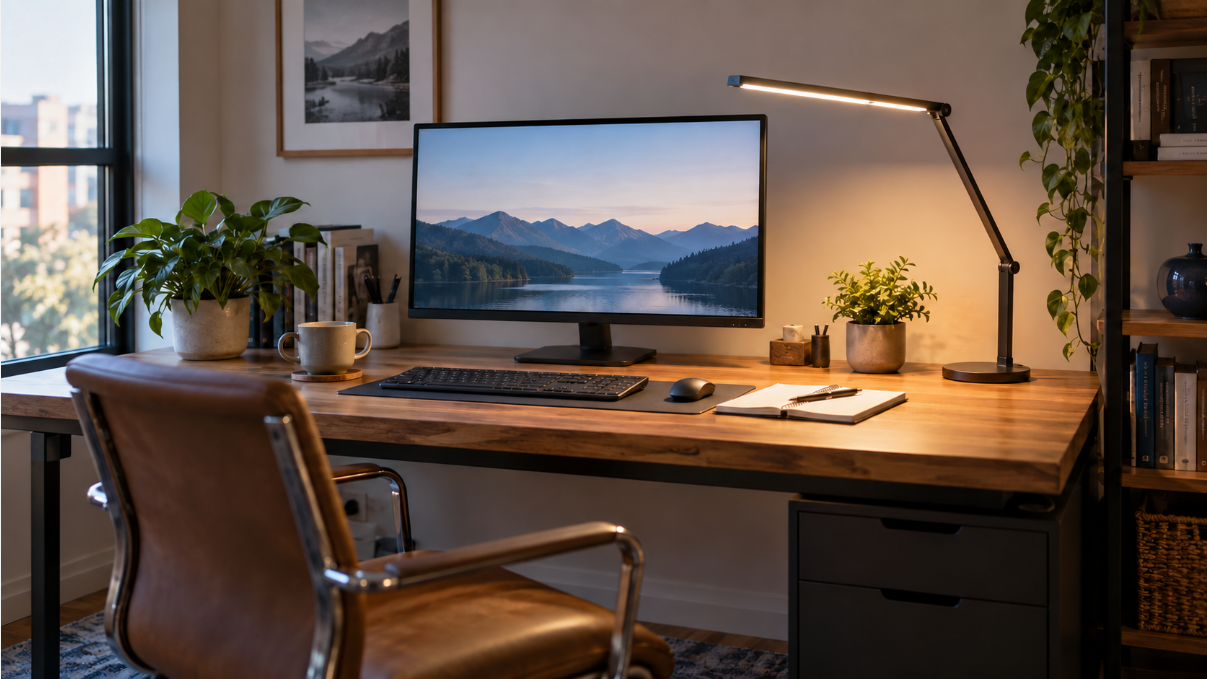
The best desk lamps for a home office should illuminate your keyboard, notes, and work surface without creating a bright reflection on your monitor. The right choice depends less on decorative style and more on three practical questions: how wide your desk is, whether you can use a clamp, and whether you need broad ambient light or concentrated task light.
For this guide, we compared six LED desk lamps with distinctly different strengths. We prioritized useful adjustment, controllable brightness and color temperature, workspace coverage, mounting style, and features that solve a real home-office problem. We did not physically test these lamps; our recommendations are based on manufacturer specifications, current Amazon listings, design analysis, and recurring buyer considerations.
Quick Picks
- Best overall: Micomlan Architect Desk Lamp — highly adjustable three-bar design with task and ambient-light options.
- Best for dual monitors: Syrinx Dual-Head Architect Lamp — extra-wide coverage and flexible positioning for larger desks.
- Best for soft, diffused light: LitONES ComforGlow F630 — edge-lit panel and freestanding base for people who cannot use a clamp.
- Best remote-controlled option: Pzloz Dual-Screen Desk Lamp — broad lighting with a wireless remote and straightforward presets.
- Best simple clamp lamp: Airlonv 17-Inch Desk Lamp — compact, flexible, and easy to position.
- Best traditional desk lamp: Lepro LED Desk Lamp — familiar base-mounted design with multiple lighting combinations.
Comparison Table
| Desk lamp | Mount | Key strength | Best for |
|---|---|---|---|
| Micomlan Architect | Clamp | Three light bars and seven joints | Flexible all-day workspaces |
| Syrinx Dual-Head | Clamp | Wide 23.7-inch light bar | Large desks and dual monitors |
| LitONES F630 | Base | Soft edge-lit illumination | Glare-sensitive users and shared desks |
| Pzloz Dual-Screen | Clamp | Wireless remote and 25 combinations | Quick changes from a seated position |
| Airlonv 17-Inch | Clamp | Simple gooseneck adjustment | Smaller workstations |
| Lepro LED Desk Lamp | Base | Compact folding design | Traditional desk setups |
Specifications and availability can change. Confirm the current listing, included controls, and mounting limits before ordering.
How We Chose
We focused on features that matter during actual desk work rather than treating the longest feature list as the winner. Broad coverage matters for a large monitor setup, but it can be unnecessary on a compact writing desk. A clamp saves surface space, while a weighted base is more practical for glass desks, thick desktops, or shared tables.
- Light control: Multiple brightness and color-temperature settings make one lamp more adaptable from focused daytime work to relaxed evening reading.
- Coverage: We favored wide or dual-head designs for monitor-heavy workstations and smaller lamps for compact desks.
- Positioning: Articulating arms, rotating heads, and stable joints help place light on the work surface instead of the screen.
- Mounting: Both clamp and base-mounted options are included because not every desktop can accept a clamp.
- Practical extras: Memory, timers, remote controls, and ambient-light modes only counted when they made daily adjustment easier.
1. Micomlan Architect Desk Lamp — Best Overall
The Micomlan is the most adaptable option in this group. Its central task light is joined by two adjustable side bars, and the listed seven-joint structure allows vertical and horizontal repositioning. Point the side bars down to concentrate light across documents and peripherals, or turn them upward to add indirect ambient light behind the desk.
The listing specifies 24W output, CRI above 90, a built-in ambient-light sensor, and an asymmetric lighting design intended to direct light toward the desk rather than into the user’s eyes or monitor. Those features make it a strong match for someone who moves between typing, paperwork, drawing, and video calls throughout the day.
Pros
- Three light bars provide flexible task and ambient lighting.
- Highly adjustable design suits changing work positions.
- Automatic brightness sensing can reduce repeated manual adjustments.
Cons
- More joints and controls create a busier look than a simple desk lamp.
- Requires a compatible desk edge for the clamp.
Best for: Users who want one lamp to cover focused work, general desk lighting, and softer background illumination.
Who should skip it: Anyone who prefers a minimalist lamp or cannot attach a clamp to the desktop.
2. Syrinx Dual-Head Architect Lamp — Best for Dual Monitors
The Syrinx is designed around coverage. Its listing describes an 18W, 2,000-lumen dual-head design with a 23.7-inch light bar, 10 brightness levels, and five color temperatures from 3000K to 6000K. The brand states that the lamp can cover a work area up to 70 inches wide, making it the most purpose-built option here for a long desk or two-monitor layout.
A 360-degree gooseneck and articulating arms provide directional control, while gesture-based on/off control can be convenient when your hands are occupied with crafts or paperwork. The timer and memory functions are useful, but the real reason to choose this model is its reach.
Pros
- Wide light bar is suited to large desks and multi-monitor setups.
- Broad brightness and color-temperature adjustment.
- Gesture control, timer, and memory add convenience.
Cons
- Oversized for a narrow laptop desk.
- A tall arm may be visually prominent in a small room.
Best for: Dual-monitor users, wide standing desks, crafting, and detailed work.
Who should skip it: Users with limited vertical clearance or a very small desk.
3. LitONES ComforGlow F630 — Best Soft, Diffused Light
The LitONES ComforGlow F630 takes a different approach from exposed rows of LEDs. Its edge-lit panel is designed to spread softer, more even illumination across the desk. The manufacturer lists 18W power, brightness up to 1,750 lux, CRI above 95, and a color-temperature range from 2700K to 6500K, along with five color modes and 10 brightness levels.
It also uses a freestanding base, so it works on desks that cannot accept a clamp. That flexibility matters for thick desktops, glass surfaces, and temporary workspaces. The tradeoff is surface space: the base occupies part of the desk, and this model does not provide the same overhead span as the widest clamp lamps.
Pros
- Edge-lit panel is designed for soft, even illumination.
- High listed CRI is useful for color-sensitive creative work.
- Base-mounted design works without a compatible desk edge.
Cons
- The base takes up more surface area than a clamp.
- Not the best option for lighting an extra-wide dual-monitor desk.
Best for: Reading, writing, design work, and users who prefer diffused light.
Who should skip it: Anyone whose priority is maximum width with zero desk footprint.
4. Pzloz Dual-Screen Desk Lamp — Best Remote-Controlled Option
The Pzloz combines broad overhead lighting with a wireless remote. According to its listing, the 24W lamp offers five color temperatures from 3000K to 5500K and five brightness levels, creating 25 lighting combinations. Its folding arms and rotating lamp heads let you spread light across a monitor setup or narrow the beam toward paperwork.
The remote is the key differentiator. It allows changes without reaching behind a monitor or touching an elevated control panel. This is especially useful when the lamp is mounted high or when the same desk is used for several tasks. The preset steps are simple, though users who want fine stepless adjustment may prefer another model.
Pros
- Wireless remote makes frequent adjustments convenient.
- Wide, adjustable structure works well above one or two screens.
- Clear preset combinations simplify setup.
Cons
- Preset brightness steps offer less fine control than stepless dimming.
- The remote is another small accessory to keep track of.
Best for: Users who want broad lighting and easy seated control.
Who should skip it: Minimalists or anyone who wants all controls built directly into the lamp.
5. Airlonv 17-Inch Desk Lamp — Best Simple Clamp Lamp
The Airlonv is a simpler choice for a compact home office. Its 17-inch light bar, flexible gooseneck, and clamp keep the design unobtrusive, while the listing specifies a 2700K–6500K color range and stepless brightness adjustment. This is enough flexibility for laptop work, reading, or evening study without the visual bulk of a multi-arm lamp.
Its smaller scale is an advantage on a narrow desk, but it also limits coverage. If you use two large monitors or regularly spread documents across a long workbench, choose a wider model. For a single-monitor workstation, however, the straightforward design may be all you need.
Pros
- Compact clamp design preserves desk space.
- Flexible neck supports quick directional changes.
- Stepless dimming allows finer adjustment than fixed presets.
Cons
- Less coverage than wider dual-head designs.
- Not ideal when several people share a large work surface.
Best for: Laptop users, students, and compact single-monitor desks.
Who should skip it: Users who need broad illumination across a large workstation.
6. Lepro LED Desk Lamp — Best Traditional Desk Lamp
The Lepro uses a familiar folding, base-mounted form rather than an overhead clamp. The listing describes a 9.5W, 750-lumen lamp with five lighting modes and five brightness levels. A frosted shade and long lamp head are intended to diffuse the light across the work area rather than create a harsh point source.
This is the easiest recommendation for someone who wants a conventional lamp that can be moved from desk to desk. It does not offer the reach or large-area coverage of the architect-style models, but its compact folding design is practical for reading, paperwork, and a modest laptop setup.
Pros
- No clamp or permanent mounting position required.
- Compact folding design is easy to move and store.
- Multiple preset lighting combinations cover common tasks.
Cons
- Smaller illuminated area than overhead multi-bar lamps.
- Base occupies usable desk space.
Best for: Readers, students, and traditional single-screen workstations.
Who should skip it: Dual-monitor users or anyone who needs light from directly above a wide desk.
Buying Guide: How to Choose a Home-Office Desk Lamp
Choose the mount before the features
A clamp is usually the best way to preserve surface space, but check the thickness, edge shape, and underside of your desktop. Cable trays, support rails, beveled edges, and glass can prevent secure installation. A weighted base is more flexible, although it takes up room.
Match the light width to the desk
A compact lamp can handle a laptop and notebook. A dual-monitor workstation benefits from a wider light bar or two adjustable heads. More coverage is not automatically better: an oversized lamp on a shallow desk can be difficult to position without glare.
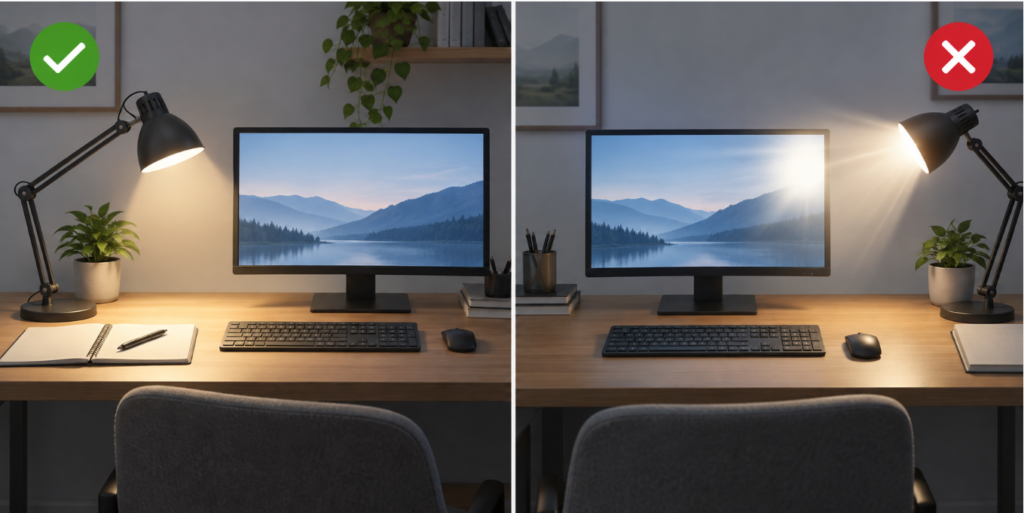
Control glare, not just brightness
Place the light so it illuminates the work surface without reflecting in the monitor. Asymmetric or angled light can help, but positioning still matters. Your screen should also sit at a comfortable level; see our guide to proper monitor height and our explanation of monitor viewing distance.
Use color temperature with purpose
Cooler white light can feel crisp for detailed daytime work, while warmer light is often more comfortable later in the evening. The useful feature is not the largest claimed range but the ability to reach a comfortable setting quickly and return to it.
Plan the entire workstation
A lamp cannot compensate for poor desk geometry. Start with a comfortable home-office desk height, then position the monitor, keyboard, and light around your neutral working posture. Our ergonomic home-office setup guide walks through the complete process.
Frequently Asked Questions
What color temperature is best for a home office?
A neutral white setting around the middle of a lamp’s range is a practical starting point for daytime work. Warmer settings may feel more comfortable in the evening. Personal comfort and room lighting matter more than one universal number.
Should a desk lamp be behind or beside the monitor?
Either can work if the light reaches the desk without shining directly into your eyes or reflecting in the screen. Overhead clamp lamps are often centered behind the monitor, while traditional lamps are commonly placed on the side opposite your writing hand to reduce shadows.
Is a clamp lamp better than a lamp with a base?
A clamp is better for saving desk space and reaching over monitors. A base is better when the desktop cannot accept a clamp or when you want to move the lamp frequently. The mounting surface should decide this choice before extra features do.
Can a desk lamp reduce eye strain?
Balanced room and task lighting may make the workspace more comfortable by reducing harsh contrast and reflections. A lamp is only one part of the setup; screen brightness, viewing distance, breaks, and monitor position also matter.
Final Verdict
The Micomlan Architect Desk Lamp is our best overall recommendation because its three adjustable bars can serve as both task and ambient lighting. Choose the Syrinx for an extra-wide dual-monitor desk, the LitONES F630 when soft diffused light and a freestanding base matter most, or the Airlonv for a simpler compact workstation.
Before ordering, measure the desk, confirm that the mounting method works, and decide where the lamp will sit relative to the monitor. The right lamp is the one that covers your actual work area without adding glare or unnecessary complexity.