Best Monitor Arms for a Home Office in 2026
This article contains affiliate links. As an Amazon Associate I earn from qualifying purchases.
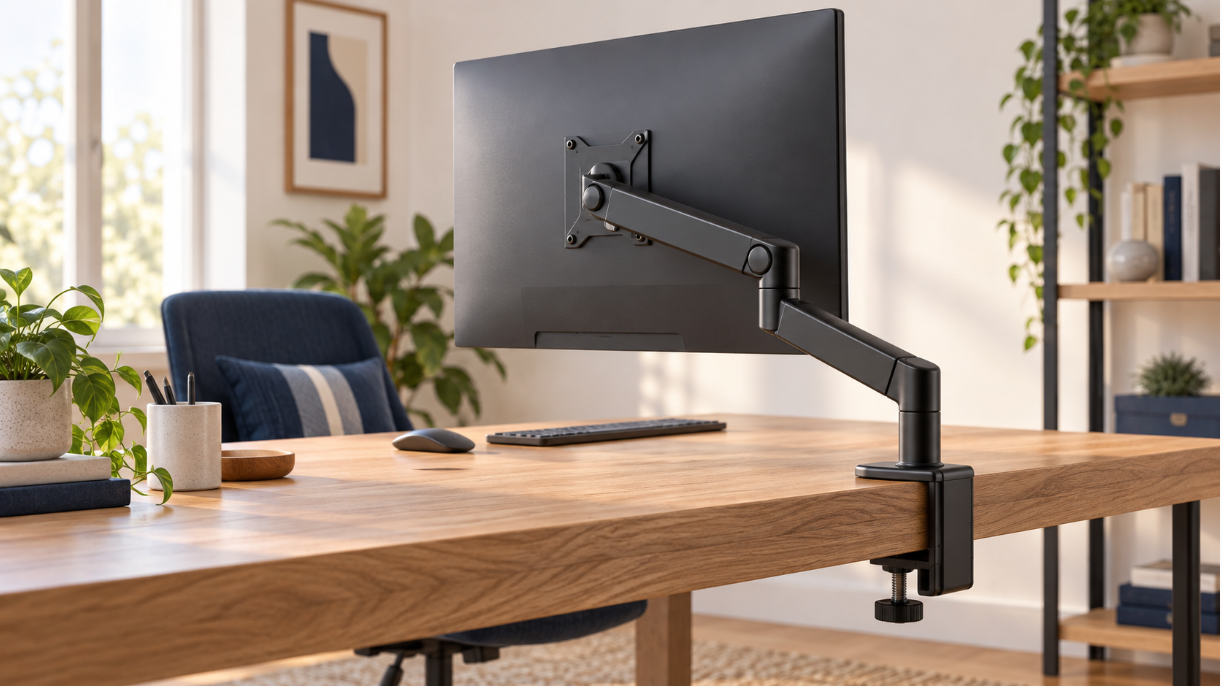
A monitor arm can free up desk space and make it easier to change screen height, distance, and angle. But the best monitor arm is not simply the model that supports the largest screen. It is the one that fits your monitor, your desk, and the way you actually work.
For this guide, we compared three monitor arms for clearly different home-office needs. The ErGear Single Monitor Arm is our best overall pick for a typical single-screen setup. The WALI GSMP001N offers a higher listed capacity for flat screens and a little more reach. The VIVO STAND-V157C is a specialized option for unusually large and heavy ultrawide monitors.
We did not physically test these products. Our recommendations are based on current manufacturer documentation, product manuals, listed compatibility, adjustment range, installation requirements, warranty information, and the practical limitations that matter before you attach a monitor to your desk.
Quick Picks
- Best Overall for Most Home Offices: ErGear EGDMA69B
- Best for More Reach and Higher Flat-Screen Capacity: WALI GSMP001N
- Best for a Heavy Ultrawide Monitor: VIVO STAND-V157C
If your monitor’s original stand already provides the height and distance you need, you may not need a monitor arm at all. Our guides to monitor height and how far your monitor should be from your eyes can help you identify the adjustment you are actually missing before you buy anything.
Comparison Table
Important: screen size alone does not determine compatibility. Check the monitor’s weight without its original stand, VESA mounting pattern, screen shape, desk thickness, and available space around the clamp.
| Model | Best For | Listed Screen Support | Listed Weight Support | VESA | Desk Mount |
|---|---|---|---|---|---|
| ErGear EGDMA69B | Typical single-monitor home offices | 13-34 inches | Up to 19.8 lbs | 75×75 or 100×100 mm | C-clamp or grommet |
| WALI GSMP001N | More reach or a somewhat heavier flat screen | Up to 34-inch curved; regular screens up to 32 inches | Up to 26.4 lbs flat; 19.8 lbs curved | 75×75 or 100×100 mm | C-clamp or grommet |
| VIVO STAND-V157C | Large, heavy ultrawide displays | Up to 57 inches | 4.4-59.4 lbs flat; 4.4-48.4 lbs curved | 75×75, 100×100, 200×100, 100×200, or 200×200 mm | C-clamp or grommet |
Specifications can change. Confirm the current Amazon listing and the manufacturer’s instructions for your exact model before ordering or installing a mount.
How We Chose
We started with compatibility rather than price or appearance. A monitor arm should support the specific display and attach safely to the specific desk. We compared the following criteria:
- Monitor fit: supported weight, screen size, VESA pattern, and separate limits for flat and curved displays where provided.
- Desk fit: clamp and grommet options, accepted desktop thickness, and installation restrictions.
- Useful movement: height, reach, tilt, swivel, and rotation for normal home-office tasks.
- Setup practicality: removable VESA plates, cable management, adjustment method, and access to instructions.
- Product confidence: available manufacturer information, warranty listing, and whether important specifications were consistent across the sources we checked.
We excluded products when their intended installation differed from a normal desk mount, when documentation was too limited for a useful comparison, or when important capacity information conflicted across available sources.
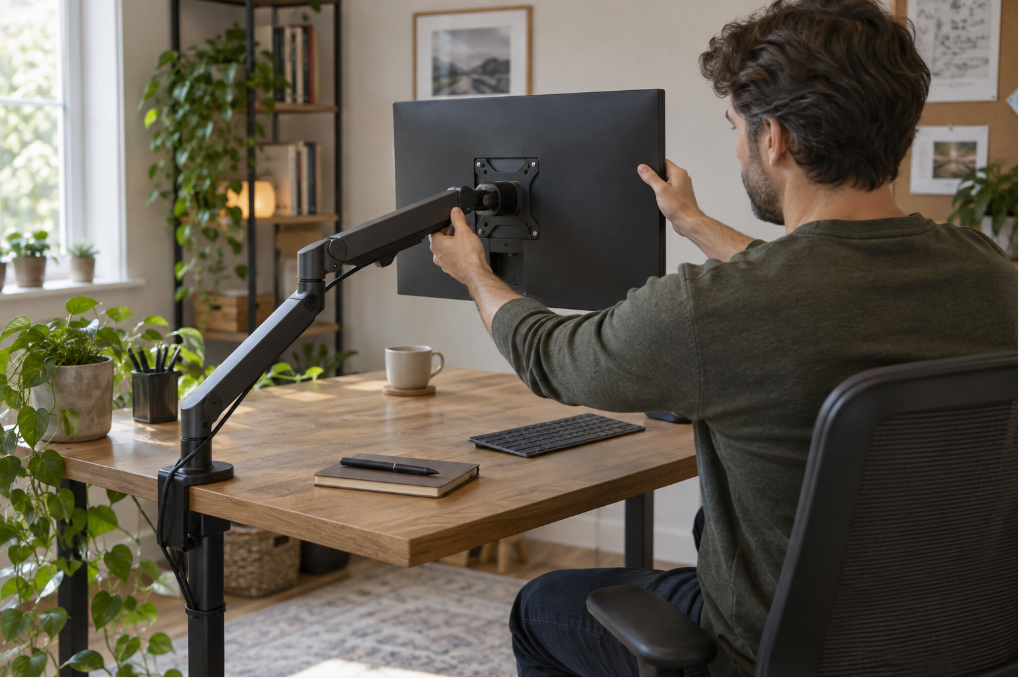
1. ErGear EGDMA69B – Best Overall for Most Home Offices
The ErGear EGDMA69B is the most balanced choice here for a common single-monitor workspace. Its Amazon listing supports most 13- to 34-inch flat or curved monitors weighing up to 19.8 pounds, with the two standard monitor VESA patterns: 75×75 mm and 100×100 mm.
Its listed adjustment range includes up to 17.5 inches of height and 18.1 inches of reach, plus +80/-50-degree tilt, 90-degree swivel in either direction, and full screen rotation. That combination is useful when you want to move the screen closer for detailed work, push it back when you need desk space, or switch between landscape and portrait orientation.
Installation flexibility is another strength. The listing includes both a C-clamp for desks 0.39 to 2.56 inches thick and a grommet option for desks 0.39 to 2.95 inches thick. A tool-free removable VESA plate can make attaching the monitor less awkward than holding the display in place while inserting every fastener.
The listed two-year warranty is shorter than WALI’s listed coverage, and the 19.8-pound limit leaves less margin for heavy ultrawides. Still, for a typical home-office monitor that fits comfortably inside all the limits, the ErGear provides a practical mix of adjustment, installation range, and cable management without moving into a specialized heavy-duty design.
Pros
- Useful height and depth adjustment for a standard single-screen setup
- Tool-free removable VESA plate
- C-clamp and grommet mounting included
- Fits common 75×75 mm and 100×100 mm VESA patterns
- Integrated cable management
Cons
- 19.8-pound capacity is not intended for the heaviest ultrawides
- Only one monitor is supported
- Gas-spring tension must be adjusted correctly after installation
Best for: Someone with one standard or moderately sized ultrawide monitor who wants flexible positioning and straightforward installation.
Who should skip it: Anyone whose monitor, after removing its original stand, approaches or exceeds the listed weight limit. Also skip it if your desk falls outside the specified thickness range or cannot safely accept a clamp or grommet mount.
2. WALI GSMP001N – Best for More Reach and Higher Flat-Screen Capacity
The WALI GSMP001N is a useful alternative when a standard single-screen arm feels slightly too limited. According to the current listing, it supports flat screens up to 26.4 pounds, while curved-screen capacity is lower at 19.8 pounds. It works with common 75×75 mm and 100×100 mm VESA patterns.
The arm is listed to extend up to 19.3 inches and rise up to 17.3 inches above the desktop. Its movement range includes +70/-45-degree tilt, 180-degree swivel in either direction, and 360-degree rotation. Compared with the ErGear, the WALI provides slightly more listed reach and more listed capacity for a flat display, although those advantages do not apply equally to curved screens.
Both C-clamp and grommet mounting are listed for desks 0.39 to 2.76 inches thick. The product page specifically recommends installation on a wooden desk and warns buyers to check for a crossbeam or other obstruction underneath. That is an important limitation: measuring only the top surface does not tell you whether the clamp will fit.
The listing describes a 10-year warranty and a gas-spring core tested through more than 20,000 movement cycles. Those are manufacturer claims rather than SmartNestLab test results, but they provide useful comparison points. We would still choose based on fit first, especially because the flat and curved weight ratings differ.
Pros
- Higher listed capacity than the ErGear for flat monitors
- 19.3-inch listed extension
- C-clamp and grommet installation
- Built-in cable routing
- Long listed warranty
Cons
- Curved-screen capacity drops to 19.8 pounds
- Manufacturer recommends a wooden desk
- An underside crossbeam can prevent installation
- Not a dual-monitor solution
Best for: A single flat monitor that needs more reach or weighs more than the ErGear’s limit but remains safely within WALI’s stated capacity.
Who should skip it: Users with glass, hollow-core, damaged, unusually thin, or otherwise questionable desktops unless the desk and mount manufacturers explicitly approve the installation. Curved-monitor owners should use the lower curved-screen weight limit, not the larger flat-screen number.
3. VIVO STAND-V157C – Best for a Heavy Ultrawide Monitor
The VIVO STAND-V157C serves a different buyer. It is designed for regular and ultrawide monitors up to 57 inches, with a listed weight range of 4.4 to 59.4 pounds for flat screens and 4.4 to 48.4 pounds for curved screens. It also supports larger VESA patterns in addition to the usual 75×75 mm and 100×100 mm options.
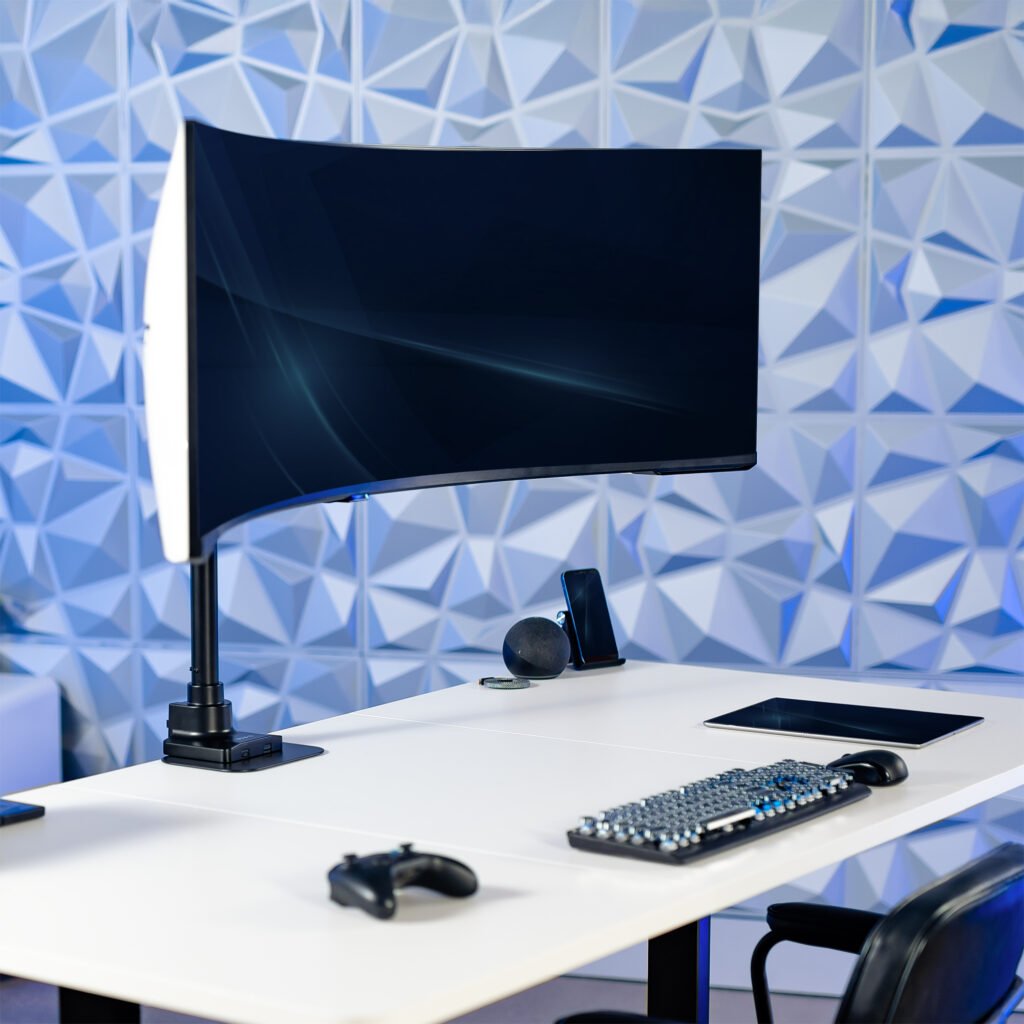
This is the strongest option in our shortlist, but that does not make it the automatic upgrade for a normal monitor. Heavy-duty arms can have minimum as well as maximum weight requirements. A screen below 4.4 pounds falls outside VIVO’s listed range, and a light monitor may not balance correctly against a spring mechanism designed for much more weight.
The design provides 14.5 inches of height adjustment along a 19.7-inch pole, with a maximum extension of 4.5 inches. It offers +55/-30-degree tilt, 180-degree swivel, and 180-degree rotation. That short forward extension is a major difference from the ErGear and WALI arms. It suits a large display that should remain relatively close to the rear of the desk, but it is less appealing if you regularly pull the screen far forward.
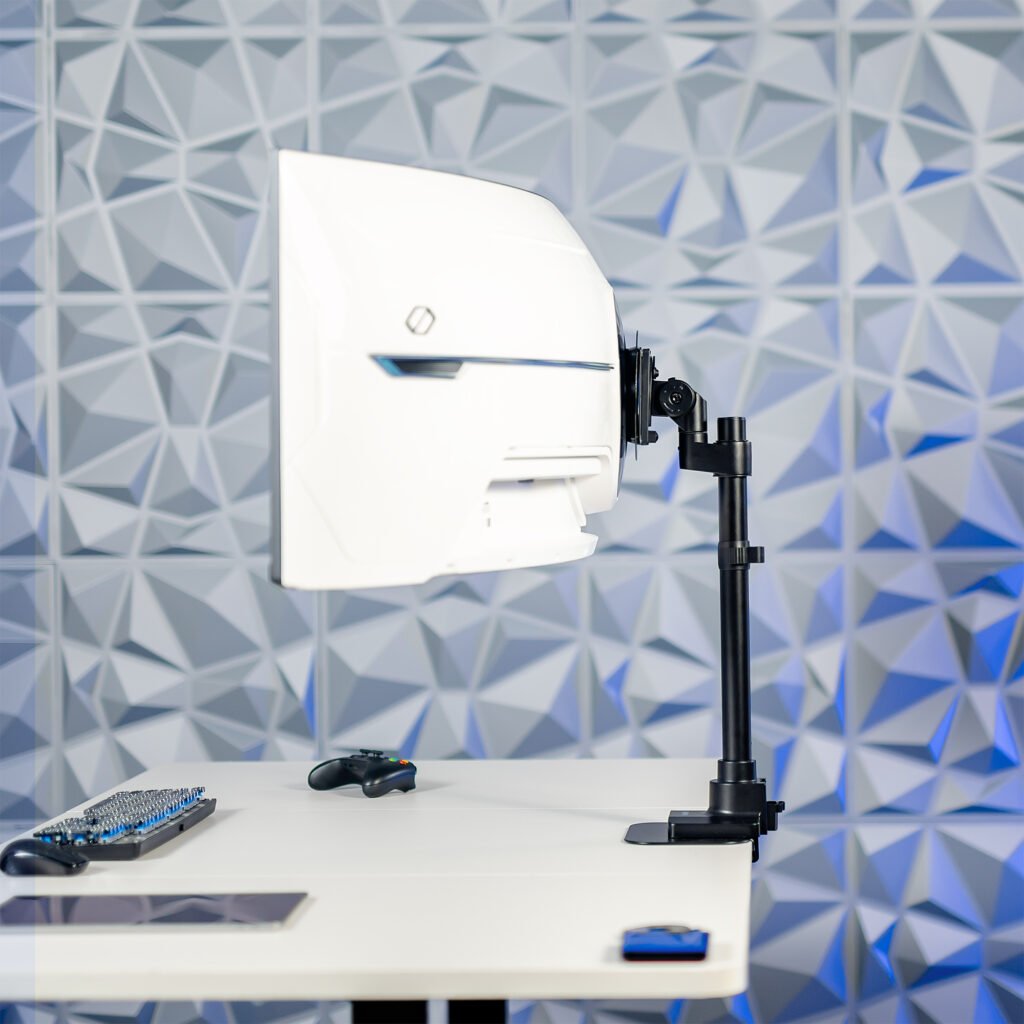
Desk fit is also more restrictive. VIVO lists a desktop thickness of 0.4 to 1.45 inches for the clamp and 0.4 to 1.25 inches for the grommet installation. The 4.7-by-4.7-inch clamp base needs a clear, suitable area on and under the desktop. Measure before buying, especially if your sit-stand desk has a frame rail near the rear edge.
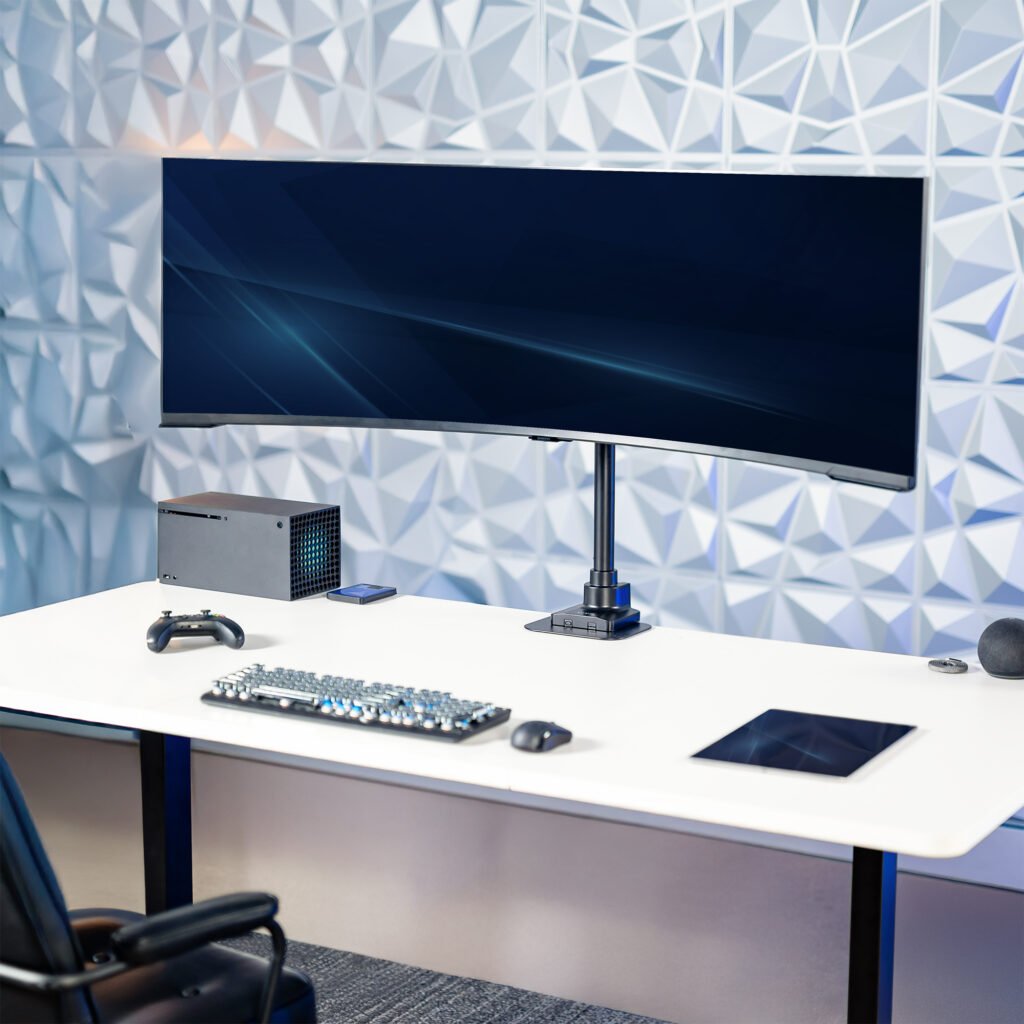
VIVO lists a three-year warranty and provides a detailed assembly manual. For someone with a genuinely large display that fits the correct flat or curved rating, that documentation is reassuring. For most conventional monitors, however, one of the lighter arms above is the more proportionate choice.
Pros
- Highest listed load capacity in this guide
- Supports ultrawide monitors up to 57 inches
- Supports several larger VESA patterns
- Separate flat and curved screen weight limits are clearly published
- C-clamp and grommet options
Cons
- Only 4.5 inches of maximum extension
- Narrower desktop-thickness range
- Large base needs sufficient clear space
- Overbuilt for a typical lightweight monitor
- Has a 4.4-pound minimum screen weight
Best for: A large, heavy flat or curved ultrawide display whose exact weight, VESA pattern, and desk installation all fit VIVO’s published ranges.
Who should skip it: Anyone who needs a long articulating reach, has a desktop thicker than the listed limit, or owns a light conventional monitor. Do not use the 59.4-pound flat-screen rating for a curved display.
Which Monitor Arm Should You Choose?
| If this describes your setup | Start with | Why |
|---|---|---|
| One typical 24- to 34-inch monitor within 19.8 lbs | ErGear EGDMA69B | Balanced adjustment and easy VESA attachment |
| A flat monitor above 19.8 lbs, or you need more forward reach | WALI GSMP001N | Higher listed flat-screen capacity and 19.3-inch reach |
| A very large ultrawide that fits the published ranges | VIVO STAND-V157C | Heavy-duty capacity and larger VESA support |
| Your monitor already reaches a comfortable position | Keep the original stand | No arm may be necessary |
Buying Guide: Five Checks Before You Order
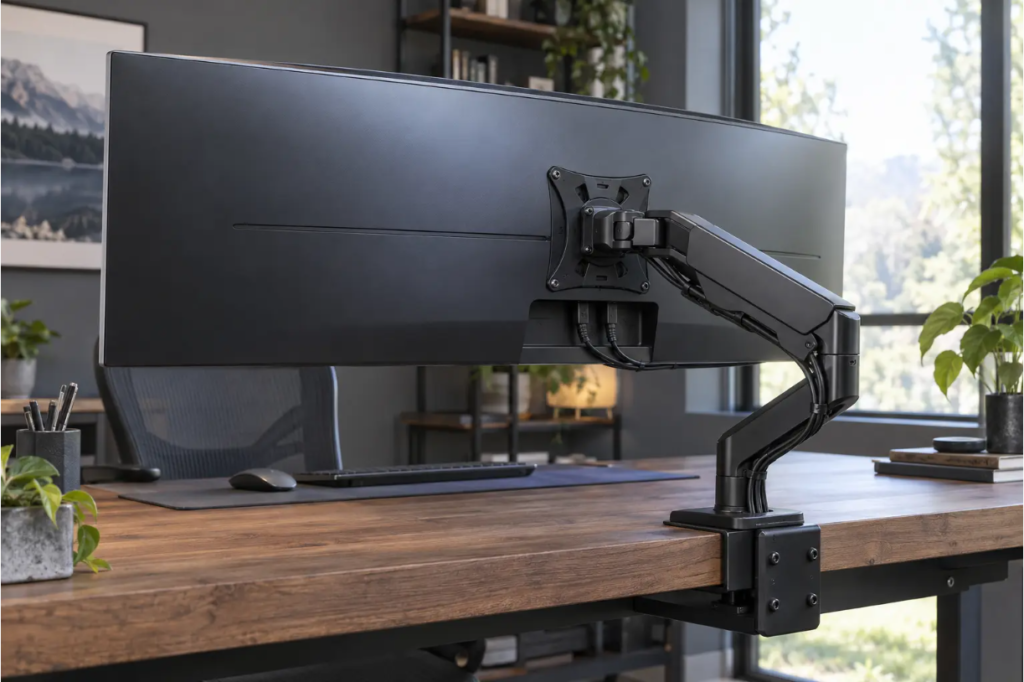
1. Find the monitor’s weight without its stand
Use the exact monitor model number and look for the display weight without the base. Do not estimate from screen size. A deep curved display can also place more leverage on the tilt joint, which is one reason some manufacturers publish a lower curved-screen limit.
2. Confirm the VESA pattern
Look for four threaded holes on the rear of the monitor and confirm their spacing in the manual. The common patterns in this guide are 75×75 mm and 100×100 mm, but VESA compliance should never be assumed from the screen size alone. Some monitors need a manufacturer-specific adapter.
3. Inspect the entire desk edge
Measure desktop thickness where the mount will actually sit. Then look underneath for a frame, drawer, cable tray, apron, bevel, or crossbeam. A clamp needs a flat and structurally suitable contact area above and below the desktop.
4. Decide how much reach you need
Height is only part of screen positioning. A shallow desk may need less forward extension, while a deep desk can benefit from a longer arm. Large monitors may need to sit farther away for comfortable viewing. Compare the arm’s usable movement with your desk depth and normal working position.
5. Plan the installation safely
Follow the current manual for the exact model. Support the monitor while attaching it, tighten hardware as directed, and adjust gas-spring tension only according to the instructions. Leave enough slack in power and display cables for the full intended movement. If the desk material or condition is uncertain, contact the desk and mount manufacturers before installation.
Frequently Asked Questions
Is a monitor arm worth it for a home office?
It can be worthwhile when the original stand cannot reach a comfortable height or distance, when you frequently reposition the screen, or when reclaiming desk space solves a real problem. A stable riser may be enough if you only need a fixed amount of extra height. Our home office desk accessories guide includes that simpler option.
Can any monitor use a monitor arm?
No. The monitor must match the arm’s supported weight, VESA pattern, size guidance, and any screen-shape limits. The desk must also support the chosen clamp or grommet installation.
Can I install a monitor arm on a glass desk?
Do not assume that you can. Concentrated clamp force can damage an unsuitable surface. Use a mount only when both the desk and mount manufacturers approve that installation and follow any required reinforcement instructions.
Is a heavier-duty monitor arm always better?
No. A heavy-duty spring arm may have a minimum screen weight, occupy more space, cost more, and offer less useful reach for a normal monitor. Choose the range that fits your display with appropriate margin rather than buying the largest number.
Do monitor arms stop screen wobble?
Not necessarily. Wobble can come from the arm, loose hardware, desk movement, a flexible desktop, or the height at which the screen is positioned. Correct installation matters, but no arm can make an unstable desk completely rigid.
Final Verdict
For most single-monitor home offices, the ErGear EGDMA69B is our best overall starting point because its compatibility and movement suit a broad range of conventional setups. Choose the WALI GSMP001N when you need its additional reach or higher flat-screen capacity. Reserve the VIVO STAND-V157C for a genuinely large and heavy ultrawide monitor that fits its stricter desk and weight requirements.
Before clicking any purchase button, write down five facts: exact monitor model, weight without the stand, VESA pattern, desktop thickness, and required reach. Those details matter more than a product’s maximum screen-size headline.
For a broader workspace check, see our practical ergonomic home office guide and our guide to finding the right desk height for your setup.