How Far Should Your Monitor Be From Your Eyes?
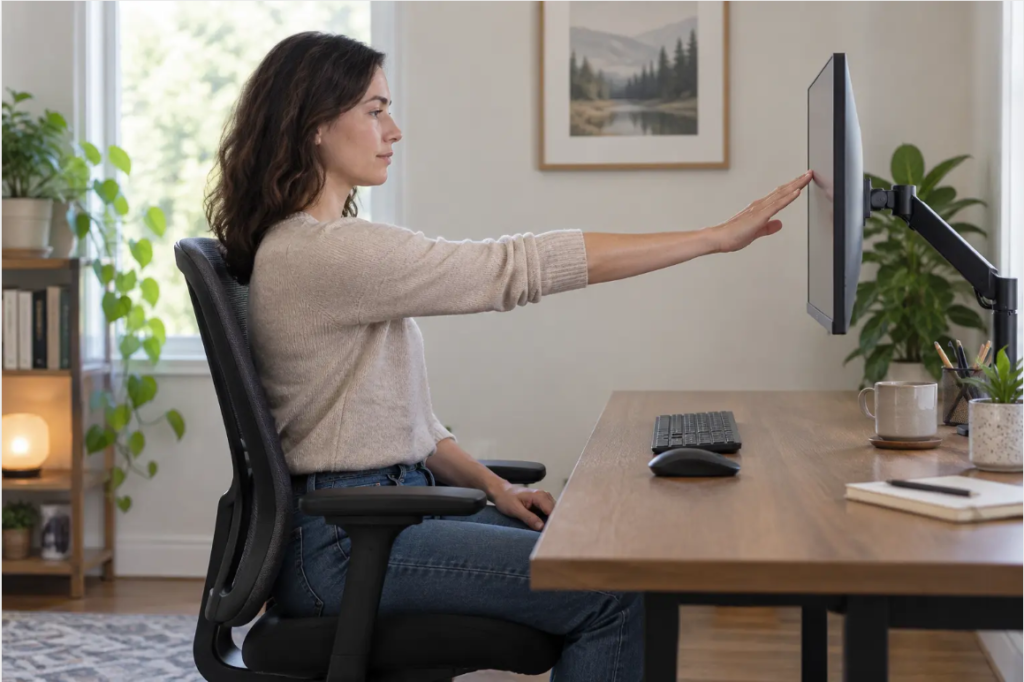
How far should your monitor be from your eyes? For most home office setups, start with your monitor about an arm’s length away—roughly 20 to 30 inches (50 to 75 cm) from your eyes. That is a practical starting point, not a rule you have to measure perfectly. Screen size, text scaling, eyesight, and the type of work you do can all change the distance that feels best.
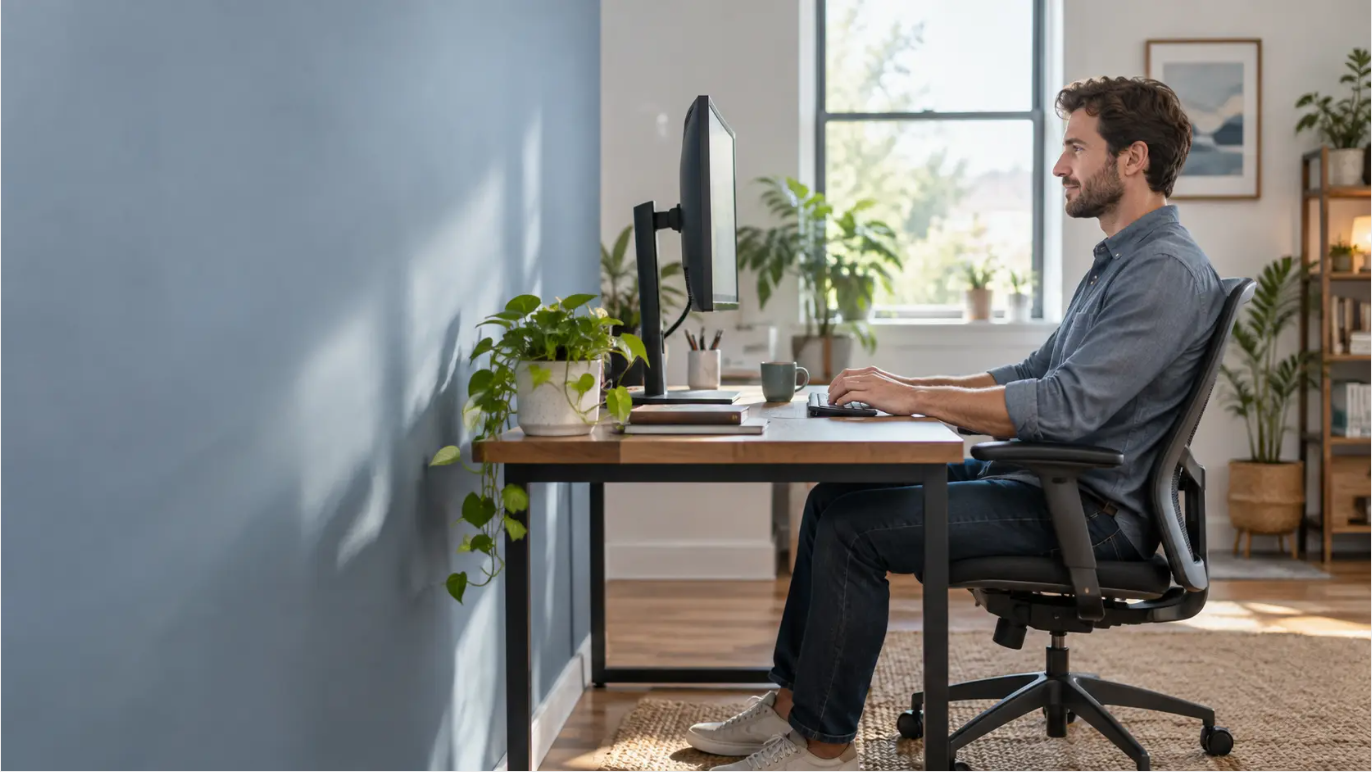
The real goal is simple: you should be able to read your normal work without leaning forward, squinting, or pulling your head back. If you can do that while keeping your shoulders relaxed and your head balanced over your torso, your monitor is probably in a useful range.
The Short Answer: Use Arm’s Length as Your Starting Point
The Canadian Centre for Occupational Health and Safety (CCOHS) shows a general viewing-distance range of about 40 to 74 cm (16 to 29 inches) and recommends using arm’s length as a practical estimate. It also notes that guidelines vary and should be adjusted for the individual.
For many people, the most useful setup process is:
- Sit all the way back in your chair in your normal working posture.
- Extend one arm toward the screen.
- Place the monitor near your fingertips.
- Open the apps and documents you use every day.
- Move the screen slightly closer or farther until the text is clear without changing your posture.
If the text looks too small at a comfortable distance, increase the operating system or browser zoom before pulling the monitor closer. That preserves a more relaxed viewing position without sacrificing readability.
A Practical Monitor Distance Decision Table
There is no single perfect number for every desk. Use the table below as a decision guide rather than a rigid specification.
| What you notice | What it may mean | What to try first |
|---|---|---|
| You lean toward the screen to read | The screen may be too far away, or text may be too small | Increase text scaling, then move the monitor slightly closer if needed |
| You pull your head back or feel visually crowded | The screen may be too close | Move it a few inches farther away |
| You turn your head often on an ultrawide | The screen may be too close for its width | Move it farther back and center your main work area |
| You crane your neck while the distance feels fine | Height or angle may be the problem | Adjust monitor height and tilt instead of changing distance |
| Glare makes the screen hard to see | Lighting, not distance, may be the main issue | Reposition the screen or light source and adjust brightness |
How to Set the Right Monitor Distance in Five Steps
1. Set your chair and keyboard first
Monitor distance should be adjusted from the position where you actually work. Sit back with your feet supported, keep your shoulders relaxed, and place the keyboard close enough that your elbows stay near your sides. If you move the monitor first and then change your chair position, the measurement is no longer meaningful.
If the rest of your workstation still needs attention, start with our practical ergonomic home office setup guide.
2. Begin at arm’s length
Extend your arm from your normal seated position. Your fingertips should land near the screen surface. This usually puts a standard desktop monitor in a sensible starting range without requiring a tape measure.
3. Test real work—not an empty desktop
Open a typical email, spreadsheet, document, or browser page. A distance that feels comfortable while looking at a large wallpaper may fail when you need to read small interface text. Test the screen with the applications you use for the longest periods.
4. Adjust text scaling before changing posture
If you instinctively lean forward, try increasing display scaling or browser zoom. On a high-resolution 27-inch or 32-inch screen, native text can be unnecessarily small. Scaling lets you keep the display at a comfortable distance while making controls and text easier to see.
5. Make small changes and retest
Move the screen one or two inches at a time. Work for several minutes before deciding. Large changes make it difficult to tell whether distance, height, brightness, or text size solved the problem.
Does Screen Size Change the Ideal Distance?
Yes, but size alone does not determine the answer. Resolution, scaling, screen curvature, and how much of the display you use all matter.
- 24-inch monitor: Arm’s length is usually a sensible starting point. Move it closer only if scaling does not make text comfortable.
- 27-inch monitor: Start around arm’s length and consider moving it slightly farther back if the screen fills too much of your visual field.
- 32-inch monitor: Many users prefer more than arm’s length, especially when the entire screen is used at once.
- Ultrawide monitor: A wider display often works better farther away so the outer edges do not require repeated head turning.
These are setup tendencies, not mandatory distances. Someone doing detailed photo work may sit differently from someone reading documents all day. The best test is whether you can see your main work clearly while maintaining a neutral posture.
Signs Your Monitor Is Too Close
- You pull your head or upper body backward.
- You feel as if the screen dominates your field of view.
- You move your eyes or head excessively to reach the edges.
- Individual pixels or text edges feel distracting at your chosen scaling.
- You have trouble taking in a full page or window without scanning.
A screen that is too close is especially common on shallow desks and with large monitors on bulky factory stands. Moving the stand back, using a deeper desk, or mounting the screen can create more usable viewing distance.
Signs Your Monitor Is Too Far Away
- You lean forward as the day goes on.
- You squint to read ordinary interface text.
- You increase zoom repeatedly but still struggle with smaller controls.
- Your head drifts in front of your shoulders.
- You avoid using parts of the screen because details are difficult to see.
Do not assume the only fix is moving the monitor closer. First check text scaling, resolution settings, lighting, and whether your current vision correction is appropriate for computer work. Persistent eye discomfort, blurred vision, or headaches are reasons to speak with a qualified eye-care professional.
Monitor Height and Distance Work Together
A correct distance cannot compensate for a screen that is much too high, too low, or off to one side. As a general starting point, place the top of the visible screen at or slightly below eye level and keep the main viewing area directly in front of you. Our guide to how high your monitor should be explains the height and downward viewing angle in more detail.
Adjust the variables in this order:
- Chair and working posture
- Keyboard and mouse position
- Monitor distance
- Monitor height and tilt
- Text scaling, brightness, and lighting
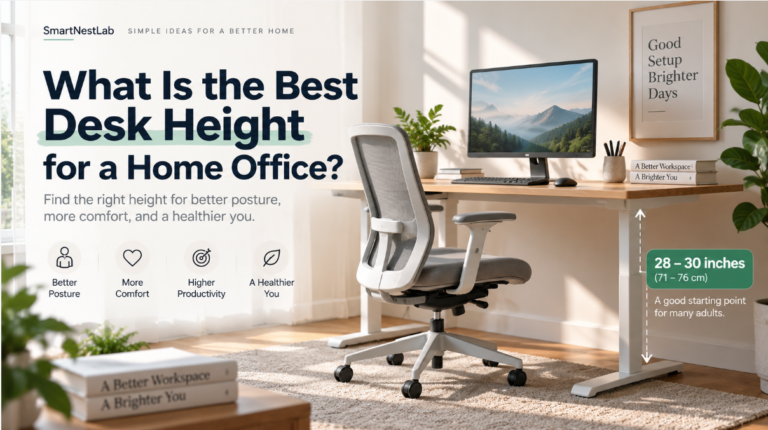
This order prevents you from “fixing” the screen by compromising another part of the workstation. Desk dimensions matter too; if your surface forces the screen too close or the keyboard too high, review the best desk height for a home office.
What About Laptops, Dual Monitors, and Ultrawides?
Laptop-only setups
A laptop creates a tradeoff: keeping the keyboard close also brings the low screen close. For longer work sessions, a laptop stand plus an external keyboard and mouse lets you adjust screen distance and height independently.
Two monitors
If you use one screen most of the time, center that monitor and place the secondary display beside it at a similar distance. If both are used equally, arrange them in a shallow arc so each screen is roughly the same distance from your eyes. Keep the seam between them close to the center of your body.
Ultrawide monitors
Start farther back than you would with a smaller screen. Place your primary application near the center rather than leaving it on an outer edge. A curved ultrawide can keep the side areas more consistent in viewing distance, but it does not eliminate the need for a comfortable overall position.
Do You Need a Monitor Arm?
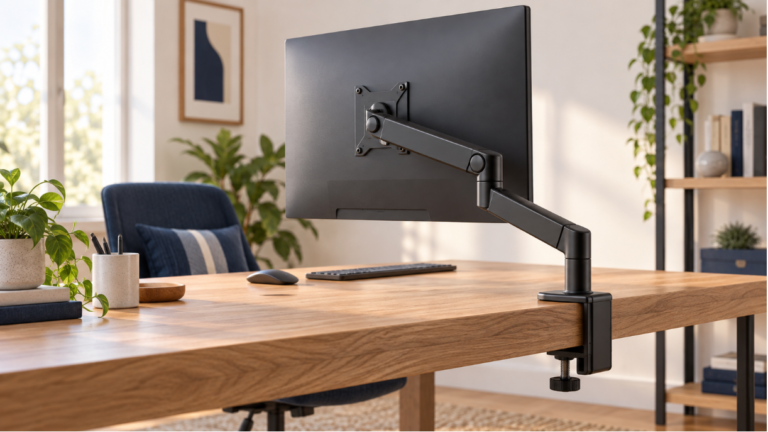
No. A stable factory stand works well when it can reach the correct height and your desk is deep enough. Books or a sturdy riser can solve a simple height problem, although they do not make forward-and-back adjustments convenient.
A monitor arm becomes more useful when:
- Your desk is too shallow for the original stand.
- You switch between sitting and standing.
- Two people share the workstation.
- You frequently move the screen for focused work or video calls.
- You need to reclaim desk space beneath the monitor.
If adjustability is the missing piece, see our research-based guide to the best monitor arms for a home office. Choose by monitor weight, VESA pattern, desk construction, and required reach—not by appearance alone.
Distance Alone Will Not Prevent Eye Discomfort
Viewing distance is only one part of a comfortable setup. Glare, dry air, uncorrected vision, long periods of close focus, and excessive brightness can still make computer work uncomfortable.
- Match screen brightness reasonably closely to the room.
- Keep strong window reflections and bare lamps out of the screen.
- Blink normally and take regular visual breaks.
- Look at something farther away periodically instead of maintaining continuous near focus.
- Increase text size rather than leaning toward the screen.
These habits support comfort, but they are not medical treatment. If symptoms continue after sensible workstation adjustments, seek advice from an eye-care or healthcare professional.
Quick Monitor Distance Checklist
- Start around one arm’s length away.
- Use your normal chair position before measuring.
- Test with real documents and applications.
- Increase scaling if you lean forward to read.
- Move large or ultrawide displays farther back when needed.
- Keep the main screen centered.
- Adjust height and tilt after setting distance.
- Recheck the setup after changing chairs, desks, or monitors.
Frequently Asked Questions
Is 20 inches too close to a monitor?
Not necessarily. Twenty inches can fall within a commonly cited starting range for a smaller monitor, but comfort and readability matter more than the number alone. If you feel crowded or move your head to see the screen edges, try moving it farther away.
Is arm’s length always the correct monitor distance?
No. It is a convenient starting point. A large ultrawide may work better farther away, while a smaller screen may need to be slightly closer. Text scaling and individual vision also affect the final position.
Should a 32-inch monitor be farther away?
Often, yes. A little extra distance can make the full screen easier to take in without repeated eye or head movement. Start at arm’s length, then move it back until the edges feel comfortable while the text remains readable.
Can sitting too close damage your eyes?
Working too close may contribute to discomfort or encourage a poor posture, but screen distance is only one factor. Lighting, breaks, dryness, brightness, and vision correction also matter. Consult an eye-care professional about persistent or concerning symptoms.
The Bottom Line
Place your monitor about an arm’s length from your eyes, then adjust it using real work as the test. You have found a useful distance when normal text is clear, the screen does not feel visually overwhelming, and you can stay back in your chair without leaning or squinting.
Do not chase an exact measurement at the expense of comfort. A few minutes spent adjusting distance, scaling, height, and lighting together will usually produce a better result than following a single number.
Sources: Canadian Centre for Occupational Health and Safety: Monitor Positioning; Mayo Clinic: Office Ergonomics.