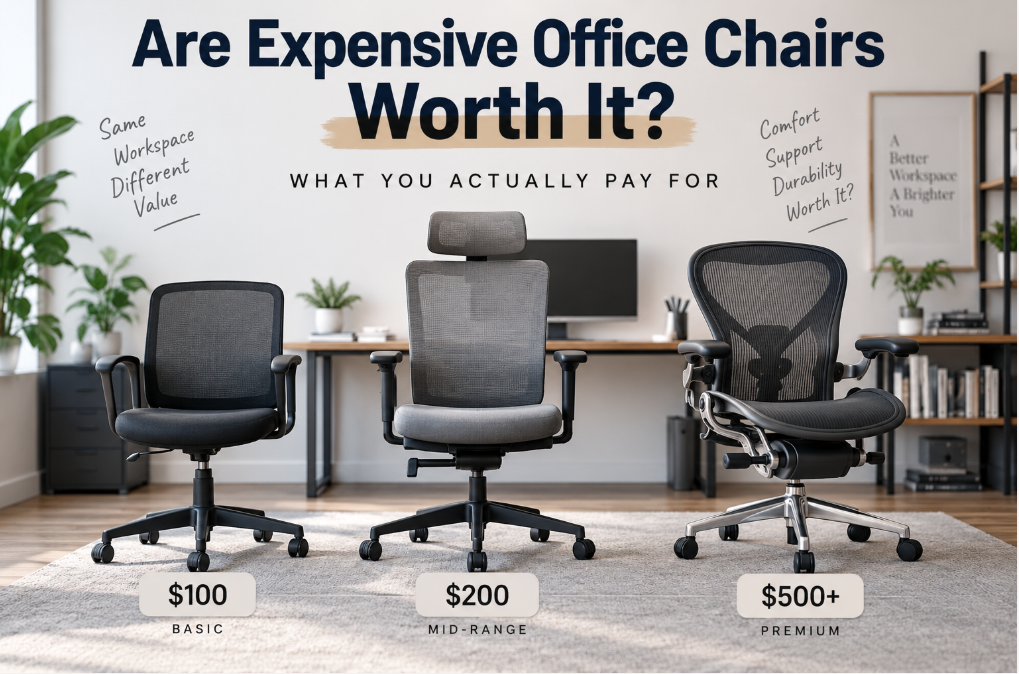
Are Expensive Office Chairs Worth It? What You Actually Pay For
If you spend several hours at a desk every day, an office chair can become one of the most important pieces of your workspace.
That naturally raises an important question:
Are expensive office chairs actually worth the money?
The short answer is: sometimes.
A more expensive office chair can offer better adjustability, materials, durability, and ergonomic features. But a higher price does not automatically mean a chair will be more comfortable or better suited to every person.
For many people, a well-designed mid-range chair can provide most of the features they actually need without spending several hundred dollars more.
The key is understanding what you are paying for and deciding which features matter for your specific workspace.
Are Expensive Office Chairs Actually Better?
Price and quality are often related, but they are not the same thing.
An expensive office chair may use higher-quality materials, offer more adjustment options, or be designed for long-term commercial use. However, some of the additional cost can also come from branding, premium finishes, or features that you may never use.
For example, someone who works at a desk for eight hours a day may benefit significantly from adjustable lumbar support, seat depth adjustment, and high-quality armrests.
Someone who only sits at a desk for an hour or two each day may not notice enough of a difference to justify spending $500 or more.
So instead of asking:
“How expensive should my office chair be?”
a better question is:
“Which features will actually improve my daily experience?”
What Are You Paying For When You Buy an Expensive Office Chair?
Higher-priced office chairs generally offer improvements in several areas.
1. Better Adjustability
One of the biggest differences between budget and premium office chairs is the number and range of adjustments.
A basic chair may allow you to adjust only the seat height.
A more advanced chair might allow you to adjust:
- Seat height
- Seat depth
- Armrest height
- Armrest position
- Backrest angle
- Recline tension
- Lumbar support
- Headrest position
- Tilt range
These adjustments can make it easier to find a position that fits your body and desk.
However, more adjustment options are only useful if you actually use them.
A chair with ten different adjustment mechanisms is not automatically better than a chair with five well-designed adjustments.
2. Better Lumbar Support
Lumbar support is another feature that often improves as you move into higher price ranges.
Cheaper chairs may use a simple fixed cushion or curved backrest.
More advanced chairs can provide adjustable lumbar support that allows you to change its height, depth, or firmness.
This can be particularly useful for people who spend long periods sitting.
However, lumbar support is highly personal.
Some people prefer strong support, while others find aggressive lumbar systems uncomfortable.
That’s why simply looking for the most complicated lumbar system is not necessarily the right approach.
The important thing is finding support that works with your body and preferred sitting position.
3. Better Materials
Premium chairs often use more durable materials and components.
Depending on the model, this might include:
- Higher-quality mesh
- More durable fabric
- Better padding
- Stronger adjustment mechanisms
- More robust chair bases
- Higher-quality casters
- More durable gas cylinders
These differences may not be obvious when you first sit down.
The bigger advantage can appear after several years of regular use.
A chair that still feels stable and comfortable after years of daily use can provide better long-term value than a cheaper chair that needs to be replaced frequently.
4. More Comfortable Armrests
Armrests are easy to overlook when buying an office chair.
But if you work at a desk for several hours a day, they can make a noticeable difference.
Basic chairs may have fixed armrests or simple height adjustment.
More expensive models may offer adjustments such as:
- Height
- Forward and backward position
- Side-to-side position
- Pivot angle
The goal is not to have the most adjustable armrests possible.
The goal is to position your arms comfortably while using your keyboard and mouse.
For people who spend most of their workday at a computer, this can be one of the upgrades worth paying attention to.
5. Better Recline and Movement
Premium office chairs often provide more sophisticated reclining systems.
Instead of simply leaning backward, the chair may allow your seat and backrest to move together or provide controlled resistance throughout the reclining range.
This can make changing positions easier during a long workday.
And changing positions matters.
Even a very ergonomic chair does not make sitting in exactly the same position for hours ideal.
A good chair should make it easy to move, recline, and adjust your position throughout the day.
6. Durability and Long-Term Value
This is one of the strongest arguments for spending more on an office chair.
Consider two hypothetical chairs:
Chair A
- Costs $150
- Works well for several years
- Limited adjustment options
Chair B
- Costs $450
- Has more adjustments
- Uses more durable components
- Remains comfortable for many years
Chair B costs three times as much initially.
But if you use it every working day for many years, the difference in cost per day can become relatively small.
This is why the purchase price alone does not tell you whether a chair is expensive.
You should also consider:
How often will I use it, and how long do I expect to keep it?
When Is an Expensive Office Chair Worth It?
A more expensive chair can make sense if you spend a significant amount of time sitting every day.
An expensive office chair may be worth considering if you:
- Work from home full-time
- Spend 6–10 hours at a desk
- Use your computer every day
- Have difficulty finding a comfortable sitting position
- Want extensive adjustability
- Plan to keep the chair for many years
- Frequently change between sitting and reclining positions
For these users, spending more can be easier to justify because the chair is used so frequently.
If your chair is essentially part of your workplace, investing in it can make more sense than treating it as ordinary furniture.
When Should You Save Your Money?
On the other hand, not everyone needs a premium office chair.
A less expensive chair may be perfectly adequate if you:
- Work at a desk only occasionally
- Sit for relatively short periods
- Already have a comfortable workspace
- Do not need extensive adjustments
- Are working with a limited budget
- Prefer a simple chair without many mechanisms
There is also an important point that is easy to overlook:
A more expensive chair cannot fix a poorly designed workspace by itself.
Your desk height, monitor position, keyboard, mouse, lighting, and sitting habits all affect how comfortable your workspace feels.
Before spending hundreds of dollars on a chair, it is worth checking whether the rest of your setup is working properly.
What Features Matter Most?
If you are comparing office chairs at different price points, focus on the features that have the biggest impact on your daily use.
1. Seat Height
Your feet should be able to rest comfortably on the floor while your knees remain in a natural position.
A chair that is too high or too low can make even a well-designed workspace uncomfortable.
2. Seat Depth
Seat depth is especially important for people with longer or shorter legs.
If the seat is too deep, you may have difficulty sitting comfortably against the backrest.
If it is too shallow, you may not receive enough support underneath your thighs.
3. Lumbar Support
Look for support that matches your body rather than simply choosing the chair with the most aggressive lumbar system.
Adjustability is often more useful than maximum support.
4. Armrests
Your armrests should allow you to position your arms comfortably while using your keyboard and mouse.
Adjustability can be particularly useful for people who work at a desk for long periods.
5. Backrest and Recline
A backrest that supports different sitting positions can make a noticeable difference during a long workday.
The ability to recline and change positions can also make the chair more versatile.
6. Seat Comfort
The seat itself should remain comfortable after extended use.
A chair that feels great for five minutes in a showroom may not feel the same after several hours.
This is one reason it is important to consider the entire chair rather than focusing on one feature.
How Much Should You Spend on an Office Chair?
There is no single price that works for everyone.
However, thinking about office chairs in broad price ranges can make the decision easier.
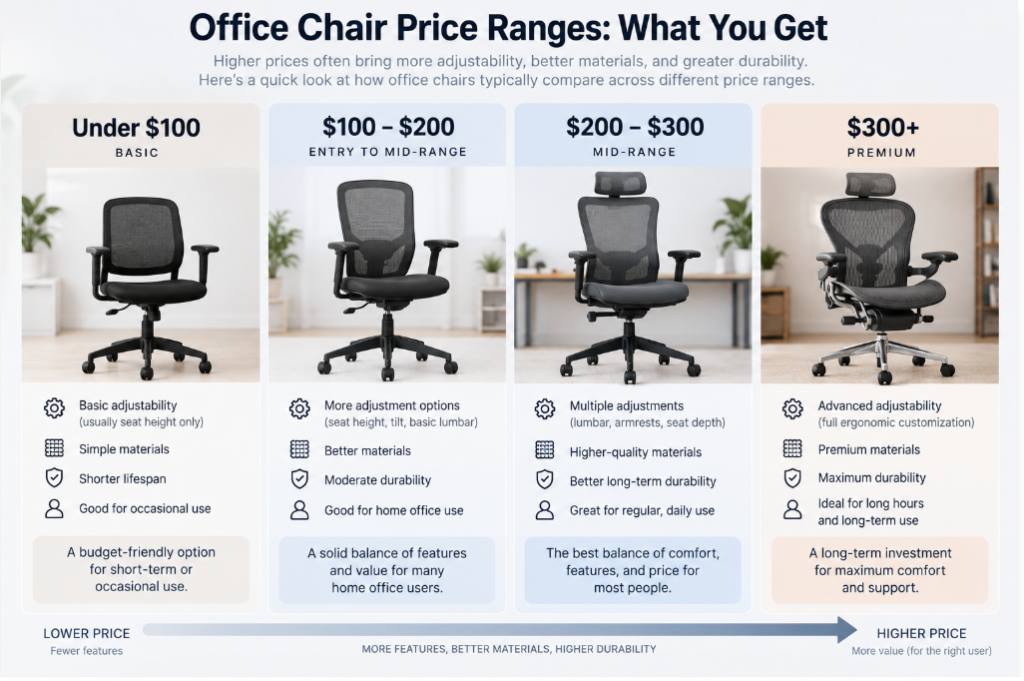
Under $100
This category is generally focused on basic functionality.
You can find usable chairs in this range, but adjustment options, materials, and long-term durability may be more limited.
These chairs can make sense for occasional use or temporary setups.
$100–$200
This is often where you can start finding more useful ergonomic features without making a major investment.
You may find chairs with adjustable lumbar support, better armrests, mesh backs, and more comfortable seat designs.
For many home office users, this can be a reasonable starting point.
$200–$300
This price range can offer a good balance between features, comfort, and cost.
You may find significantly better adjustability and construction compared with entry-level models.
For someone who works from home regularly, this is often a price range worth exploring.
You can also see our guide to the Best Office Chairs Under $300 if you want to compare several options in this range.
$300 and Above
At this level, you are increasingly paying for premium materials, advanced adjustment systems, long-term durability, brand reputation, and specialized ergonomic designs.
That does not mean every chair above $300 is automatically a better choice.
The additional cost should provide something meaningful for your specific needs.
Is a $500 Office Chair Better Than a $200 Chair?
Not necessarily.
A $500 chair may be better constructed and offer more adjustment options than a $200 chair.
But whether it is better for you is a different question.
For example, you may not need:
- An advanced headrest
- Multiple recline settings
- Highly adjustable armrests
- Premium materials
- Specialized lumbar mechanisms
If you never use those features, paying more does not necessarily improve your experience.
On the other hand, someone who spends most of their waking workday at a desk may appreciate these upgrades much more.
The best chair is not necessarily the most expensive chair.
It is the chair that provides the features you actually need at a price you are comfortable paying.
Don’t Forget About Your Entire Workspace
An office chair is only one part of an ergonomic workspace.
If your monitor is too low, your keyboard is positioned poorly, or your desk is the wrong height, upgrading your chair may only solve part of the problem.
A good home office setup should consider:
- Chair height
- Desk height
- Monitor position
- Keyboard and mouse position
- Lighting
- Foot support
- Ability to change positions
For more guidance, see our How to Set Up an Ergonomic Home Office: A Practical Guide.
Making small improvements to your entire workspace may provide more noticeable benefits than simply buying the most expensive chair you can afford.
So, Are Expensive Office Chairs Worth It?
They can be, but only when the additional features provide real value for you.
If you spend most of your day sitting at a desk, investing in a higher-quality chair can make sense.
You may benefit from better adjustability, more durable materials, improved support, and a chair that remains comfortable over a longer period.
But if you only use your desk occasionally, spending $500 or more may not be necessary.
For many people, a well-designed chair in the $100–$300 range can provide an excellent balance of comfort, features, and value.
Instead of focusing on the price tag, focus on the features that affect your everyday experience.
Buy the chair that solves your problems—not simply the chair with the highest price.
Final Thoughts
An expensive office chair is an investment, but it is not automatically a better investment.
The right price depends on how often you use the chair, how long you plan to keep it, and which ergonomic features actually matter to you.
If you work from home every day, spending more can be reasonable.
If you only sit at your desk occasionally, a simpler and more affordable chair may be all you need.
The goal is not to find the most expensive office chair.
The goal is to find the best value for the way you actually work.